
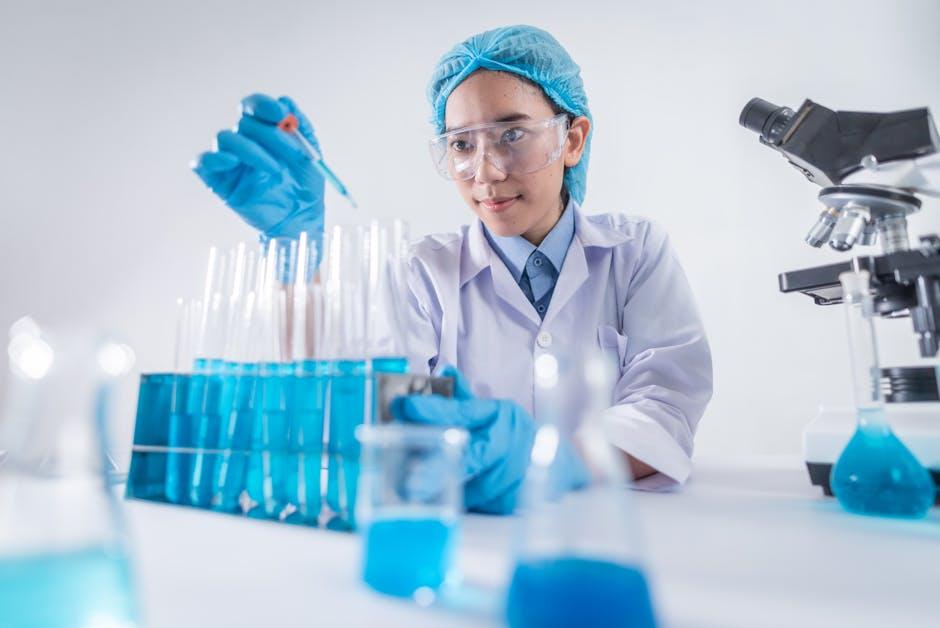

For decades, the path from a promising molecule to a life-saving medication has been grueling-a marathon measured not in months, but in years. Scientists have labored in the labyrinth of trial and error, wiht the average drug taking a decade-and billions of dollars-to cross the finish line. But what if the race could be run faster? Today, artificial intelligence is emerging as biotech’s new pace-setter, reshaping the drug revelation landscape and accomplishing in 12 months what once took 10 years. In this article,we’ll unravel how AI is transforming science fiction into pharmaceutical fact,slashing timelines,amplifying hope,and bringing tomorrow’s cures a giant step closer to today.
Table of Contents
- the Evolution of Drug Discovery Embracing Artificial Intelligence
- Breaking Down Traditional Barriers Accelerating Research Timelines
- Harnessing AI Power real World Success Stories and Transformative Partnerships
- Navigating Challenges and Charting a Responsible Future for AI in Drug discovery
- In Conclusion

The Evolution of Drug discovery Embracing artificial Intelligence
Imagine compressing a decade of laborious drug growth into a single, intensely focused year. thanks to the accelerating synergy between AI-powered algorithms and pharmaceutical R&D, what once demanded 10 years of trial and error is now being condensed into just 12 electrifying months.
- Deep learning models scan and interpret billions of chemical compounds in days, pinpointing promising molecules with uncanny speed.
- Natural language processing combs thru existing medical literature, uncovering hidden links between diseases and potential treatments.
- Generative AI doesn’t just repurpose old molecules-it creatively proposes entirely new drug candidates, engineered to fit precise biological targets.
| Traditional Method | AI-Driven Approach |
|---|---|
| Compound screening: years | Compound screening: weeks |
| Manual analysis | Automated predictions |
| High failure rates | Early-stage filtering |
A new cadence is taking hold in the life sciences: speed, precision, and sheer possibility. With AI leading the charge, pharmaceutical teams are breaking paradigms, reducing risks, and daring to imagine a future where life-saving drugs emerge with unprecedented velocity. Wrapping neural networks around the tangled puzzles of biology may prove to be the most consequential innovation in medicine since the discovery of penicillin.

Breaking Down Traditional Barriers Accelerating Research Timelines
For decades, researchers slogged through painstaking trial-and-error processes, waiting years for promising compounds to inch through the R&D pipeline. Now, artificial intelligence is dismantling these legacy obstacles, creating a landscape where molecules leapfrog from concept to clinic with unprecedented speed.
- Algorithmic Prediction: AI models rapidly identify potential drug candidates by analyzing billions of data points-compressing years of discovery work into a matter of weeks.
- Virtual Screening Revolution: Instead of physically testing thousands of compounds, researchers use AI engines to simulate interactions, immediately focusing on the most promising leads.
- Automated Experimentation: Robotic platforms guided by smart algorithms execute and optimize experiments round-the-clock, slashing the trial cycle time drastically.
| Traditional Approach | AI-Driven Workflow |
|---|---|
| Manual target validation | Automated AI target selection |
| Bulk compound screening | Predictive digital screening |
| Sequential experiments | Parallel robotic analysis |
| Linear pipeline | Real-time iterative feedback |
these advances translate into a tangible impact on research timelines. Rather of the traditional 10-year marathon to bring a new medicine to market, smart platforms are now charting a course from hypothesis to human trials in just 12 months. The fusion of AI and automation is not just accelerating discovery-it’s rewriting the tempo of pharmaceutical innovation.
Harnessing AI Power Real World Success Stories and Transformative Partnerships
Imagine shrinking the pace of medical breakthroughs from a decade to just a handful of months. Recent advances in artificial intelligence are turning this vision into reality, slashing the average drug discovery timeline from the industry-standard 10 years down to as little as 12 months. This quantum leap isn’t just a victory for science; it’s a lifeline for patients, reducing the wait for life-saving treatments through data-driven collaboration between pharmaceutical innovators and AI trailblazers.
- Machine learning algorithms swiftly predict molecular interactions, replacing years of lab trial and error with precise virtual simulations.
- Partnerships between AI startups and pharmaceutical giants are accelerating every stage-from target identification to preclinical testing.
- Large-scale analysis of patient data enables personalized therapies and faster identification of safe, effective drug candidates.
- Automated lab robotics powered by AI are running experiments around the clock, compressing timeframes and multiplying productivity.
| Stage | traditional Timeline | AI-Powered Timeline |
|---|---|---|
| Target Identification | 2 years | 3 months |
| Lead Optimization | 3 years | 6 months |
| Preclinical Testing | 2 years | 2 months |
| Total | 7+ years | ~12 months |
As technology and human expertise intertwine, these transformative partnerships are writing new rules for healthcare. The AI-driven revolution in drug discovery doesn’t just promise faster cures-it’s fundamentally reshaping both the efficiency and inclusivity of medical research, offering hope and healing at an unprecedented pace.
Navigating Challenges and Charting a Responsible Future for AI in Drug Discovery
Imagine walking into a lab where drug discovery isn’t a decade-long waiting game, but a thrilling race completed in months. This isn’t science fiction-it’s the transformative effect of artificial intelligence-driven workflows in today’s pharmaceutical industry. Machine learning models pore over massive datasets, predict molecular behavior, and optimize compound selection with a precision no team of humans could match. Suddenly, tasks that once demanded years of incremental progress-target identification, screening, and validation-are streamlined, slashing not just time but also costs.
- AI-enabled simulations accurately forecast drug performance, reducing the need for prolonged lab experiments.
- Automated platforms rapidly sort through billions of chemical possibilities for the most promising leads.
- Predictive algorithms anticipate toxicity and side effects, minimizing late-stage failures.
| Process Step | Traditional Timeline | With AI |
|---|---|---|
| Compound Screening | 2-3 years | 2-3 months |
| Lead Optimization | 1-2 years | Weeks |
| Preclinical Testing | 4-6 years | 6-12 months |
such acceleration isn’t merely about speed; it’s about bright design.Innovation now demands the balancing act of harnessing AI’s potential while vigilantly safeguarding against algorithmic bias, data privacy breaches, and lack of transparency. But with each iteration,the promise grows clearer: a smarter,more agile pipeline,putting life-saving therapies into the hands of patients far sooner than ever imagined.
In Conclusion
As AI continues to revolutionize drug discovery, the drastic reduction from a decade-long process to just 12 months marks more than a technological achievement-it redefines the future of healthcare. By accelerating the identification and development of life-saving treatments, AI opens the door to faster responses against emerging diseases and personalized medicine tailored to individual needs. This conversion not only promises greater efficiency but also holds the potential to save countless lives worldwide. As we stand on the cusp of this new era, staying informed and engaged with these advancements is essential. Join the conversation, share these insights, and explore how AI’s evolving role could shape the next chapter in medical innovation.